The Best "Me" is Situational
As a Biology major, I study the relationships within species and between multiple species. These relationships not only apply to the population level of biology, but can be studied at the micro-level when dealing with different individuals that can affect one another. Specifically in my Biology 301 Ecology and Evolution class, I learned about symbiotic relationships, which are the biological interactions between species. One symbiotic relationship is called mutualism. In mutualistic relationships, both organisms must do their part to ensure that they will benefit from the unity. For example, bees fly from flower to flower, gathering nectar to convert into food. When a bee lands in a flower, pollen falls on their bodies. When the bee travels to the next flower, some of the pollen rubs off, pollinating the plant. From this interaction, bees benefit by producing food to eat and flowers are able to reproduce. Symbiotic relationships are important to our ecosystems because it provides a balance that is achieved through working together. A part of my study guide is attached that explains symbiotic relationships. Collaborating with others is only beneficial when each person is putting in their best effort. In my Organic Chemistry 333 class, an essential concept to understand when dealing with substances is resonance structures, which show the relationship between a single molecule and its contributing structures. A single Lewis structure can move their electrons from one atom to another to be in their most stable conformation. When they are in this state, they can interact with other molecules to produce the most effective product. Included below is an example of a resonance structure from my class to help further explain this concept to those not familiar with this topic.
Electrons are able to move from the oxygen atom to the bond between the oxygen and nitrogen,
as well as move from the bond between the nitrogen and oxygen atoms to the single oxygen
atom. A structure will change their conformational for stability reasons and to produce the major product.
A mutualistic relationship that I have experienced in my time at the University of South Carolina is my relationship with a co-instructor to teach University 101. University 101 is an introductory course designed for freshmen students to aid in their transition into college. It was first introduced to the University of South Carolina in 1972 to foster communication and develop meaningful relationships between students and staff members. I became a Peer Leader to my co-instructor Dr. Chris Burkett. Our goal was to provide the students with information about campus resources that the University provides but also to promote diversity and personal development within themselves. Before the semester began, Dr. Burkett and I constructed a syllabus to outline the topics we would cover throughout the semester. One class that was significant to me as a Peer Leader was the lesson about Values and Identity. First semester of college can be challenging academically, emotionally, and physically. Dr. Burkett and I constructed a lesson that allowed the students to reflect on themselves and where they stood at that particular time in the semester. The discussion focused on what values were most important to students and the differences in values between them. It was interesting to hear the students talk from experience about their priorities, which allowed me to understand the students more below the surface level. With the conjoined effort by Dr. Burkett and I, we were able to create a valuable lesson for students to aid in their personal development. Working alongside Dr. Burkett for a semester by fostering the success of the students with meaningful lessons, we were able to create an environment for students that was open and safe for everyone.
From this experience, I learned the importance of completing
my tasks and working with another individual to create a cohesive
output. There is a saying ,“Two minds are better than one”, which I
came to realize is actually true. I am capable of facilitating discussion
on my own, but having Dr. Burkett to bounce off ideas turned into
a more engaging class. It was essential that both Dr. Burkett and
I fulfilled our own parts of the lesson to ensure a beneficial end.
It is only a mutualistic relationship when we are able to learn and
gain more insight from one another. I highly value my relationship
with Dr. Burkett because it gave me the opportunity to expand on
my leadership skills and interact with students not only as their
mentor, but also as a friend. My experience as a Peer Leader has
been a learning curve for me and I hope to use the skills that I
gained to propel me into my professional goals in medicine.
Having a good working relationship with others is productive only when I am able to ensure that I am applying my strengths to every situation. Not every interaction I have with people will be the same so I should be aware and adjust my strategies and skills to produce an effective end. As an Orientation Leader, it made me become adaptable when working with other Orientation Leaders each session, and also when interacting with the incoming students and their families. Applying one approach to one person will not always work for another because everyone receives and responds in varying levels. Working with a different partner for each Orientation session was an exciting task for me. I know the best leadership strategies that work for me but taking the time to learn, understand, and compromise on an approach with my partner requires effort. It is important that I am able to analyze each situation and present a reasonable response to the individual involved. As an Orientation Leader, being my best self varies depending on what will be most valuable to the people that I interact with, just like how resonance structures will adapt to its environment. I learned that the level of productivity that I put forward will help contribute to the success of any working relationship.
During the summer, I encountered thousands of incoming students, some who were excited to be there and some who were not as happy. I became aware that group activities can be intimidating for some students and that they socialize better in smaller groups. I made sure that everyone in my small group would feel welcomed in the group setting, but also give each person their individualized attention. Everyone is genetically different and so it is important that I am able to adapt to each situation with a new mindset and approach the conversation in a way that makes the individual feel comfortable. Like resonance structures, I am able to readjust my manner that is best suitable for the situation.
In my future as a medical physician, I will be working with various medical professionals to treat patients and help them live a better and healthy life. Every patient that I encounter will have a different medical issue with varying symptoms. It is my job to understand the patient’s body as it relates to them and come to a diagnosis with a treatment plan that will benefit them the most. However, it is also important that I take into consideration the work of nurses and the knowledge of other doctors. Working in a hospital is not a one-man’s job but requires the collaboration of every medical professional. Cooperating with others will not only allow me to learn new skills and approaches but will help me grow as a medical physician. I believe that it is important for me to continually learn from my experiences with patients and with other doctors. I will be able to expand on my knowledge, create a more inclusive environment with other professionals, and become a better physician for my patients.

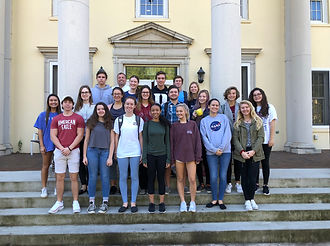
My University 101 class of 19 freshmen students that I co-instructed with Dr. Burkett. This picture was taken on the first day of class to capture the beginning of a great semester.

A small portion of Orientation Leaders that I got to work with in the summer of 2017. We started as co-workers who soon became close friends.